Livingston FC is younger than most of its supporters. The club has played under the town’s name only since 1995, but its history goes back to 1943 and to a factory floor in Edinburgh. Understanding that is the key to the whole story, including why some people in Edinburgh still talk about Meadowbank Thistle with a certain bitterness.
From Ferranti to Meadowbank
The club started as Ferranti Amateurs, the works team of the Ferranti engineering company, playing in the Edinburgh amateur leagues. By 1948 it was Ferranti Thistle, and in 1953 it moved into senior football in the East of Scotland League. It found a ground at City Park in Edinburgh in 1969 and joined the Scottish Football Association in 1972.
The club’s first appearance in the Scottish Cup came on 16 December 1972, against Duns, and in 1973 it won the Scottish Qualifying Cup.
The break came in 1974. The Scottish Football League was reorganising into three divisions and needed a new member. Ferranti Thistle beat off Highland League clubs and others and won the vote 21 to 16 over Inverness Thistle. There were two problems. League rules did not allow a sponsor’s name in a club’s title, and City Park was not good enough. The council offered Meadowbank Stadium, built for the 1970 Commonwealth Games, and a newspaper competition produced the new name: Meadowbank Thistle.
The Meadowbank years
Meadowbank Thistle spent twenty-one seasons in Edinburgh without ever drawing big crowds. The first manager, John Bain, had a matter of weeks to turn a works side into a league team, and the first competitive game, in the League Cup, ended in a 1–0 defeat by Albion Rovers. Their best spell came in the mid-1980s: promotion to the First Division in 1983, the Second Division title in 1986–87 and then second place in the First Division in 1987–88, which would have meant promotion to the top flight if league reconstruction had not got in the way.
The decline was quick. Relegated in 1993 and again in 1995, the club dropped into the new Third Division. Chairman Bill Hunter said it faced closure, and a move was agreed: a new stadium in Livingston, built as a joint venture with the Livingston Development Corporation, and a new name. Many Meadowbank supporters objected to both.
Almondvale and the rise
The club played its first months as Livingston FC at Meadowbank before Almondvale Stadium opened in November 1995. What followed is still the most remarkable run in the club’s history. Livingston won the Third Division in 1995–96, the Second Division in 1998–99 and the First Division in 2000–01, reaching the Scottish Premier League six seasons after the move.
Then they finished third. In 2001–02, under Jim Leishman, the club came in behind only Celtic and Rangers and qualified for the UEFA Cup. They got past FC Vaduz of Liechtenstein on away goals and then lost an extraordinary tie to Sturm Graz of Austria, 8–6 on aggregate. Almondvale’s record crowd, 10,112, was set that first season against Rangers on 27 October 2001.
The trophy came in 2004. With Davie Hay as manager, Livingston beat Hibernian 2–0 in the League Cup final at Hampden, Derek Lilley and Jamie McAllister scoring. For a club that had been fighting for survival in Edinburgh nine years earlier, it was quite a day.
Two administrations
The money had not kept up with the football. Weeks before that final, on 3 February 2004, the club went into administration, and it did not come out until May 2005, under Pearse Flynn’s Lionheart consortium. Managers came and went, and in May 2006 Livingston were relegated from the SPL with 18 points, at the time the worst record the league had seen.
Worse followed in 2009. After debts to West Lothian Council, which owns Almondvale, went unpaid, the Court of Session put the club into administration on 24 July. Liquidation began. A late deal with new owners saved Livingston as a club, but on 5 August 2009 the Scottish Football League demoted them two divisions to the Third Division. The administrator called it the death knell.
There was a bleak symmetry to the first match under the new owners. Livingston lost 3–0 to Albion Rovers in the League Cup, the same opponents who had beaten Meadowbank in the club’s first league-era game in 1974.
It was not the end. Livingston won the Third Division in April 2010 and the Second Division in April 2011, back-to-back titles that took them straight back to the second tier.
Livingston FC history since 2010
The decade after that was rarely calm. A Challenge Cup win in 2014–15, 4–0 against Alloa, came in a season that also brought a points deduction for unpaid tax and a last-day escape from relegation. The escape ran out a year later, when a play-off defeat by Stranraer sent the club down to League One in 2016.
Under David Hopkin, Livingston FC bounced straight back, winning League One in 2017, and then beat Partick Thistle 3–1 on aggregate in the 2018 play-off final to return to the top flight for the first time since 2006. The club finished fifth in the curtailed 2019–20 season and sixth in 2020–21, and reached the League Cup final again in 2021. Since then Livingston have moved between the top two divisions, which is roughly where the club’s size and the town’s population put it.
The club and the town’s employers
The shirts tell the economic story of Livingston almost as well as the history books. Mitsubishi was the first major sponsor in the Livingston era, for the first three seasons. Motorola followed for four years, then withdrew at the end of 2001–02 as the company’s local operations declined, one of the clearest signs of Silicon Glen’s retreat. Intelligent Finance, then one of the largest employers in West Lothian, took over in 2002 for five years. Later deals came from local companies such as Fasteq and Energy Assets.
Almondvale Stadium
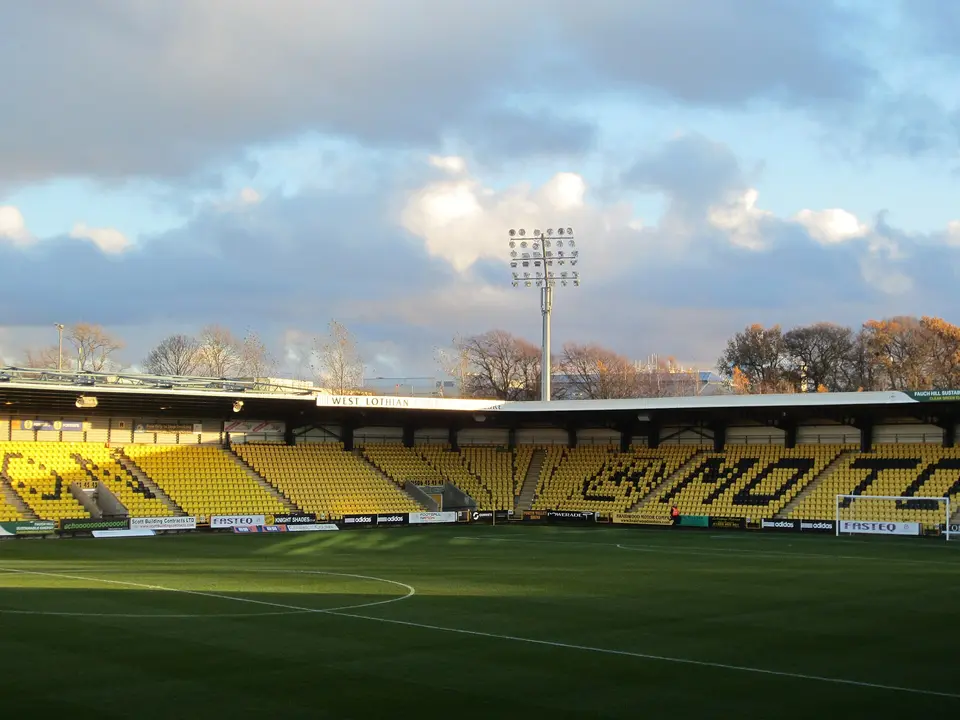
The ground sits on the north-western edge of the town centre, beside the River Almond and close to the shopping centres. It holds 9,713, all seated, in four single-tier stands of similar height, with a five-storey stadium house in one corner used for offices and conferences. It was the last major project of the development corporation; when the corporation was wound up, the stadium passed to West Lothian Council, which rents it to the club.
Almondvale has been renamed for sponsors more often than any ground needs to be: the West Lothian Courier Stadium, the City Stadium, back to Almondvale in 2005, the Braidwood Motor Company Stadium from 2010, the Energy Assets Arena from 2013, and from 2015 to 2024 the Tony Macaroni Arena, which fans and journalists nicknamed the Spaghettihad. Whatever the current name, locals call it Almondvale, and so does this guide. It has a longer record in the women’s game than many people realise: Almondvale hosted a Scotland v England women’s international in August 1997, became the Scottish Football Association’s centre for women’s football in 2001 and staged the national team’s home matches until 2004. Hibernian Women played their home games here in 2021–22. Youth internationals and Challenge Cup finals have been played here too.
Going to a match
Amber and black are the colours, as they have been since 1943, and the club is known as Livi or the Lions. If you are coming from outside the town, the travel guide has train and bus details: the bus terminal on Almondvale Avenue is about five minutes from the ground, and Livingston North station is half an hour on foot. Food and drink before the game is easiest at the shopping centres or around the town centre, covered in the restaurants guide.
One small thing to look for on the club crest: it carries the Latin motto Fortiter omnia vincit, roughly “bravely conquers all”. After 2009, few clubs had more right to it.