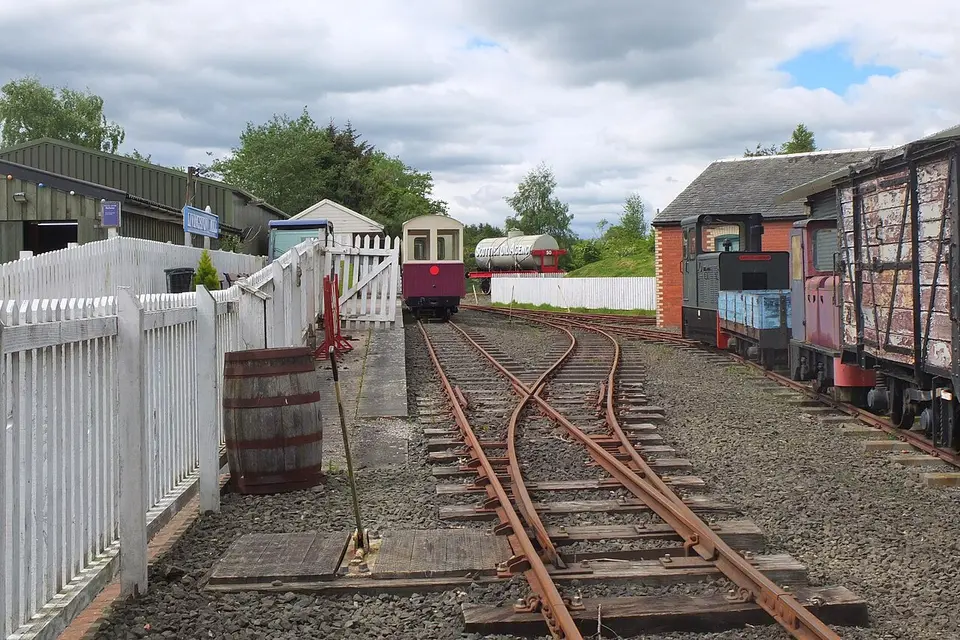
The Almond Valley Light Railway runs on track just 2 ft 6 in wide, and on a summer afternoon it carries more delighted toddlers per mile than any other line in Scotland. It belongs to the Almond Valley Heritage Centre at Millfield, on the southern edge of Livingston, which is where most visitors with children end up sooner or later. It is also the best place to understand what this land was before the new town: a shale oil district, a mill and a scatter of farms.
Almond Valley Heritage Centre
The centre occupies a former mill on the River Almond near Livingston Village. It is part farm, with animals that children can get close to, part play park and part museum. The Museum of the Scottish Shale Oil Industry, created in 1990, explains how West Lothian had the world’s first oil boom. By 1870 more than three million tons of shale were being mined each year around Livingston, and the industry only finally ended in 1962, the very year the new town was designated.
That coincidence is worth pausing on. The town that replaced the mining villages was planned in the same year the last shale works closed. The heritage centre tells that story better than any sign in town, and the railway, the old wagons and the agricultural machinery on display make it concrete for younger visitors.
Howden Park and the arts centre
North of the town centre, across the Almond, Howden Park is the largest open green space near the middle of Livingston. At its northern end stands Howden House, completed in the late eighteenth century, whose buildings now hold the Howden Park Centre. The arts centre has a 300-seat theatre with plays, concerts and recitals, and it is home to Firefly Youth Theatre.
The park itself is simple: lawns, mature trees, paths and the river. It is the obvious place to walk off a shopping trip, since the malls are a few minutes away on foot. The Howden district guide covers the area in more detail.
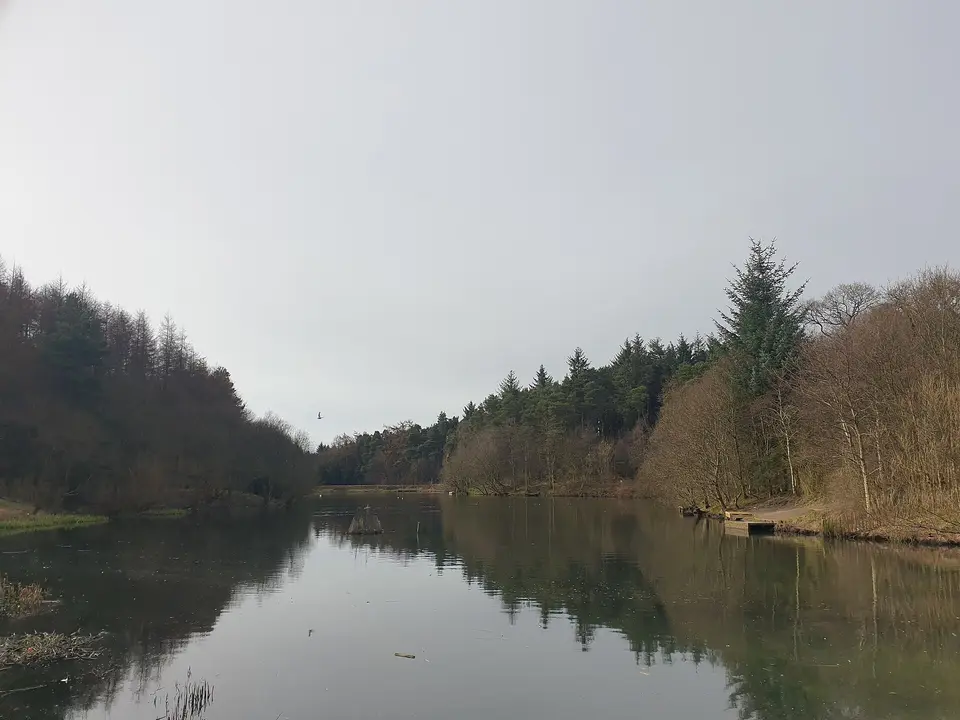
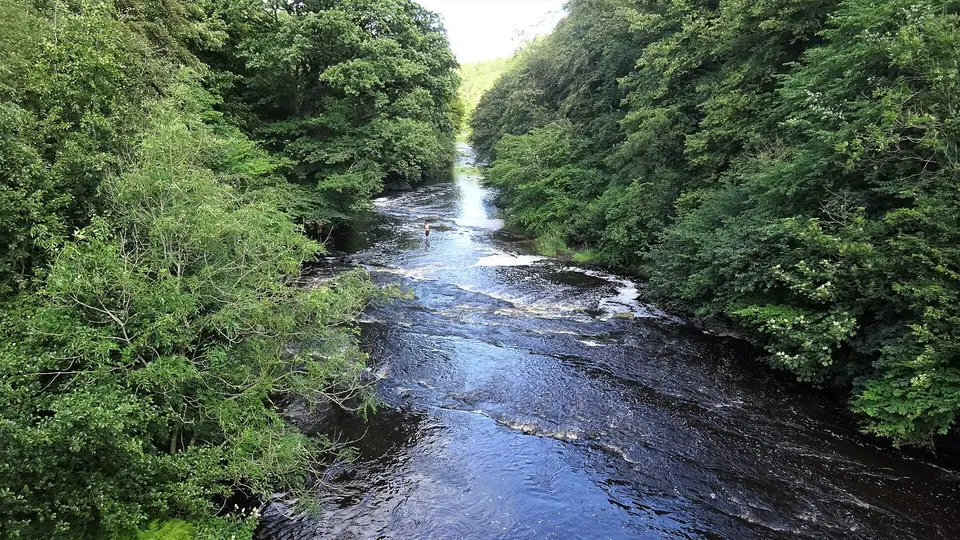
Eliburn Reservoir in the north-west of the town. · The Almond from the Nasmyth Bridge at Almondell.Photo: LordHarris, CC BY-SA 4.0Photo: Rosser1954, CC BY-SA 4.0
The skatepark that made the textbooks
Livingston Skatepark opened in 1981, at a time when most commercial skateparks in Britain were closing. Designed by the Scottish architect Iain Urquhart, it was free and unsupervised, and it became one of the most important skateboarding facilities in the country during a critical decade for the sport. In 2020 BBC Radio 3 devoted a documentary, Curves and Concrete, to its influence on later skateparks across the UK.
You do not need to skate to appreciate it. The concrete bowls are a piece of 1980s civic design in their own right, and on a dry evening the park is busy with riders of every age. Sit at the edge and watch; nobody minds.
Eliburn Park and the reservoir
In the north-west of the town, Eliburn Park covers 16.5 hectares around a reservoir fed by the Nell Burn. West Lothian Council owns it, and it has fishing access, sports facilities and a children’s play area. The circuit of the water is short and flat, which makes it popular with pushchairs and older walkers. The Eliburn page has more on the surrounding district.
The Murieston Trail and the river paths
Livingston’s planners separated walkers from traffic wherever they could, and the result is a core path network that reaches almost every district. The Murieston Trail in the south of the town runs through woodland beside the Murieston Water, crossing it on footbridges and an old stone bridge, and it is the most rural-feeling walk inside the town boundary. It starts within easy reach of Livingston South station.
The River Almond paths link the town centre with Howden, Craigshill and Livingston Village. Walking the whole length takes a couple of hours and passes more of the town’s history than any driving route.
Churches, bridges and other small sights
Some of Livingston’s best details are not attractions at all. St Andrew’s Church in Craigshill, designed by George R. M. Kennedy and Partners in 1968 and completed in 1970, is a notable piece of Brutalist church design: a dramatic concrete form that is easily seen from the street. In Livingston Village the Old Kirk dates in its present form from 1732 and stands on the site of a church recorded from around 1350. Peel Park nearby recreates the mound and moat of the medieval tower that once stood there, with planting that echoes the old gardens.
Then there are the roads themselves. Livingston was built around grade-separated junctions, roundabouts, underpasses and footbridges, following the Radburn idea of keeping pedestrians and cars apart. It is not everyone’s idea of a sight, but if you are interested in how towns are made, an hour spent on the path network tells you more than any guidebook. Pick a district, follow the paths rather than the roads, and notice how rarely you have to cross traffic at all.
Almondell and Calderwood Country Park
Just east of Livingston, between Mid Calder and East Calder, Almondell and Calderwood Country Park covers about 220 acres of wooded river valley. Its visitor centre occupies the converted coach house and stables of Almondell House, a 1786 mansion demolished in 1969. The Nasmyth Bridge over the Almond, designed by Alexander Nasmyth in 1810 and restored in the late 1990s after a partial collapse in 1973, is the park’s best-known sight. The Camps Viaduct of 1885 now carries a footpath.
VisitScotland rates the park as a four-star visitor attraction. For a half-day walk close to Livingston, it is the strongest choice.
Linlithgow Palace, a short drive north
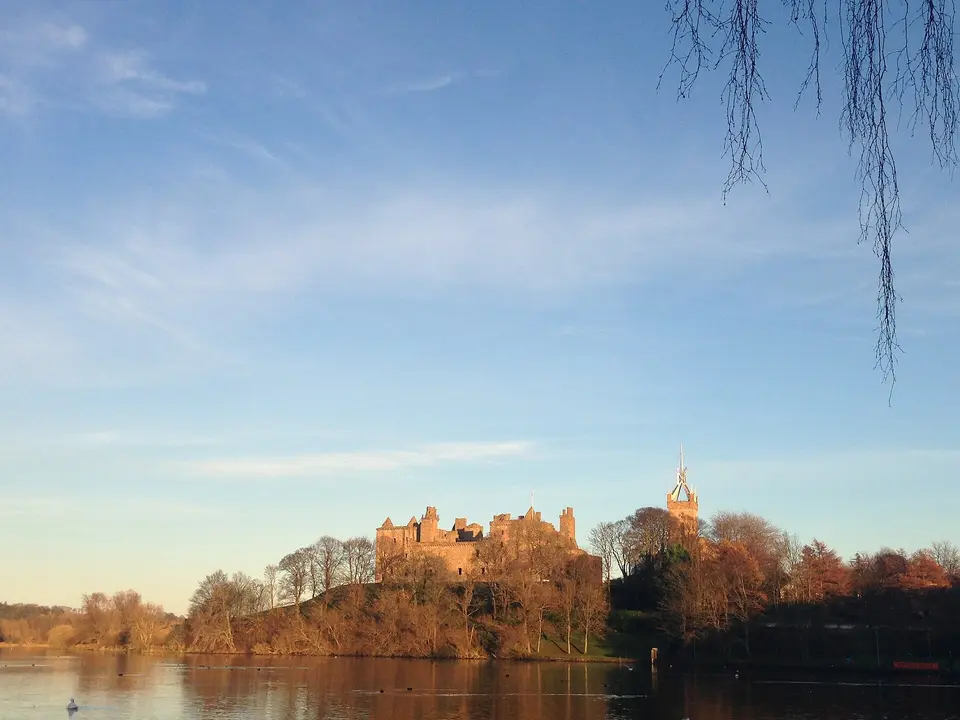
Outside the town, the obvious excursion is Linlithgow Palace, about fifteen miles west of Edinburgh and a short drive north of Livingston. The ruined royal palace was one of the principal residences of the Scottish monarchs in the fifteenth and sixteenth centuries, was burned out in 1746, and is now cared for by Historic Environment Scotland. Mary, Queen of Scots, was born there in 1542. The West Lothian attractions page covers it with the rest of the county.
Planning the day
A realistic day in Livingston without a car might combine the heritage centre in the morning, lunch in Livingston Village and a walk along the Almond to Howden Park in the afternoon. With a car, add Almondell or Linlithgow. The skatepark is best at the end of the day, when the light is low and the bowls are full of riders.
Weather matters more than anything else, and in West Lothian it changes fast. Most of these places are outdoors, and a wet day narrows the choice to the heritage centre’s indoor exhibits, the arts centre and the malls.