Seen from the M8 on a clear evening, the Five Sisters look like something out of a children’s drawing: five red-brown cones lined up on the skyline south of West Calder. They are in fact a shale bing, the waste of the industry that made West Lothian the site of the world’s first oil boom, and they are now a scheduled monument. If you want to understand the county around Livingston, start with them. Almost everything else in this guide is older, grander or prettier, but nothing else explains the landscape as quickly.
The sights below are arranged roughly by direction from Livingston. The ones inside the town, such as the heritage centre and the skatepark, are on the Livingston attractions page.
North: Linlithgow and its palace
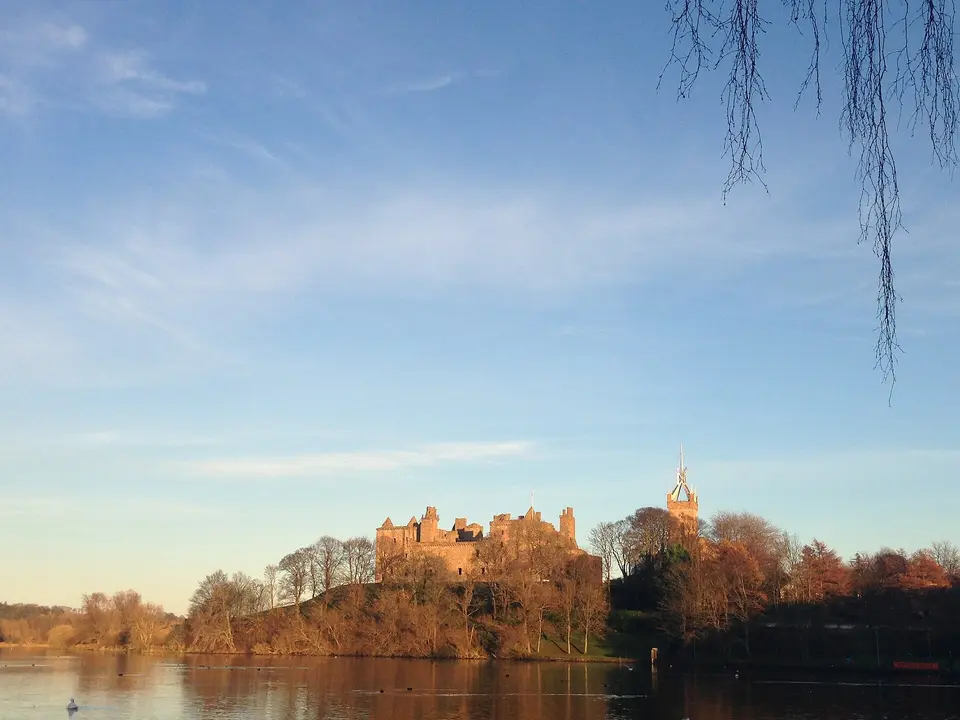
Linlithgow is the county’s old royal burgh, a few miles north of Livingston across the M8. Its palace was one of the principal residences of the Scottish kings and queens in the fifteenth and sixteenth centuries. A royal manor stood on the site from the twelfth century, and Edward I’s occupying army fortified it in 1301 and 1302. The palace that replaced it was little used after the court moved to London in 1603 and was burned out in 1746. Historic Environment Scotland now cares for the ruin.
Even roofless, it is impressive. The courtyard fountain, the great hall and the views over Linlithgow Loch reward an hour or two, and the loch path makes a pleasant circuit afterwards. Next door, St Michael’s Parish Church carries a modern aluminium crown on its tower, a 1960s addition that divides opinion in the town to this day.
North-east: Blackness Castle on the Forth
A few miles further on, Blackness Castle sits on a spit of rock in the Firth of Forth. Sir George Crichton built it in the 1440s, when Blackness was the port for Linlithgow, and it passed to the Crown in 1453. Over the centuries it served as a state prison, an artillery fortress strong enough to be among the most advanced in Scotland, and a garrison, before Cromwell’s army took it in 1650.
Its long, narrow shape earned it the name of the ship that never sailed, with towers known as the stem and the stern. Film crews love it: it appeared in the 1997 Ivanhoe and, more famously, in Outlander. On a calm day you can see both the Forth Bridge and the Queensferry Crossing to the east.
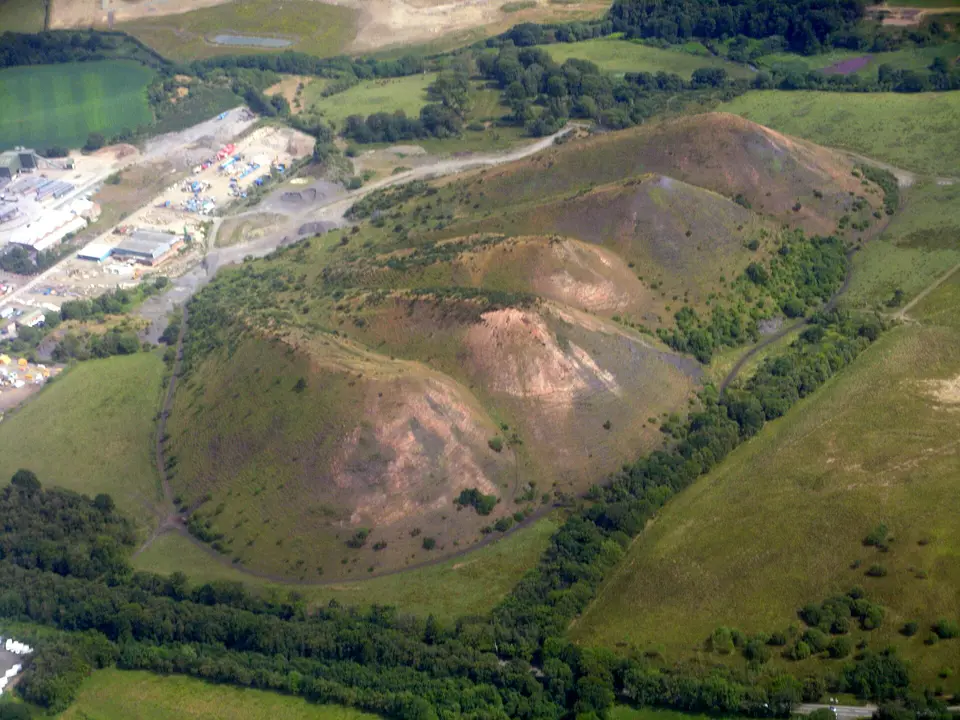
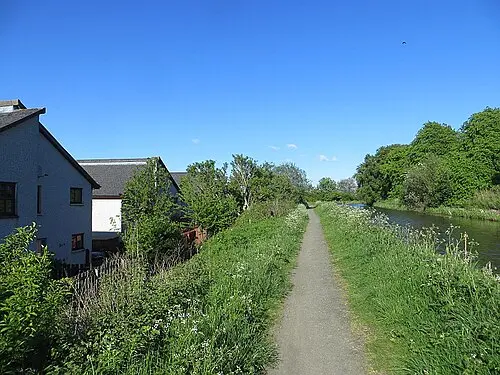
The Five Sisters, a scheduled monument of the shale oil industry. · The Union Canal at Linlithgow.Photo: M J Richardson, CC BY-SA 2.0Photo: Richard Webb, CC BY-SA 2.0
Above Linlithgow: Beecraigs Country Park
In the Bathgate Hills south of Linlithgow, Beecraigs Country Park is the county’s main outdoor playground: woodland trails, a loch, a deer herd and plenty of room for children. It sits high enough that the views stretch across the Forth on a clear day. Locals tend to pair it with a walk up to Cairnpapple Hill nearby, a prehistoric ritual site above Bathgate with signs of activity going back to around 3500 BC.
South-west: the Five Sisters and the Calders
Back to the bings. The Five Sisters stand just outside West Calder, a few miles south-west of Livingston, and a path now leads around them. Greendykes bing near Broxburn is the county’s other scheduled shale monument. Together they are what remains of an industry that mined more than three million tons of shale a year around Livingston by 1870 and finally stopped in 1962.
To the east of the bings, Mid Calder and East Calder sit above the River Almond. Mid Calder has stood on a crossroads since the eleventh century, and Calder House near the middle of the village has been the seat of the Sandilands family, the Lords Torphichen, since 1348. Between the two villages lies Almondell and Calderwood Country Park, the nearest big green space to Livingston.
Along the Union Canal
The Union Canal runs from Edinburgh to Falkirk and passes through Linlithgow, where the canal centre has a basin and boats. The towpath makes flat, easy walking and cycling in either direction, and the Avon Aqueduct west of Linlithgow carries the canal high over the river valley. The canal feeder that supplies it with water starts near Almondell, which is how a Livingston walk can end on the canal without a car.
West towards Falkirk: the Kelpies and the Wheel
Strictly speaking these are in Falkirk council area, not West Lothian, but nobody who lives in Livingston minds the distinction. The Kelpies, two thirty-metre steel horse heads by the sculptor Andy Scott, stand in the Helix park beside the M9. A few miles away, the Falkirk Wheel lifts boats 24 metres between the Union Canal and the Forth and Clyde Canal. It opened in 2002 and is the only rotating boat lift of its kind in the world.
Both are free to see from outside, and both are better in person than in photographs. The day trips page suggests how to fit them into a day with Stirling or Edinburgh.
Putting a day together
With a car, the classic circuit from Livingston is Linlithgow Palace in the morning, lunch in Linlithgow, Blackness Castle in the afternoon and back by the Forth. Children usually vote for Beecraigs instead of the castle. Without a car, Linlithgow is the easiest target, with buses and trains linking it to the Livingston area; the rest is easier with wheels. Whatever the plan, check the opening season first: several of these places keep shorter hours or close entirely in winter, and the castle and palace are both exposed to the weather off the Forth.