People sometimes call Livingston a city. It isn’t one. In September 2021 the town entered the Platinum Jubilee civic honours competition and asked for city status; when the results came out in 2022, Livingston was not among the winners. It remains a town, the largest in West Lothian and the third-largest in Scotland, and in practical terms that changes nothing for anyone who lives or works here.
How big is Livingston?
The 2011 census counted 56,269 people in Livingston, up from 50,826 in 2001. That makes it the second-largest settlement in the Lothians after Edinburgh and roughly the eighth-largest in Scotland, ahead of several places that do hold city status. Perth, Stirling and Inverness, all cities, are smaller. The statistics office draws the locality a little wider than most residents would, taking in Uphall Station and Pumpherston, and its larger urban area adds Mid Calder and East Calder as well.
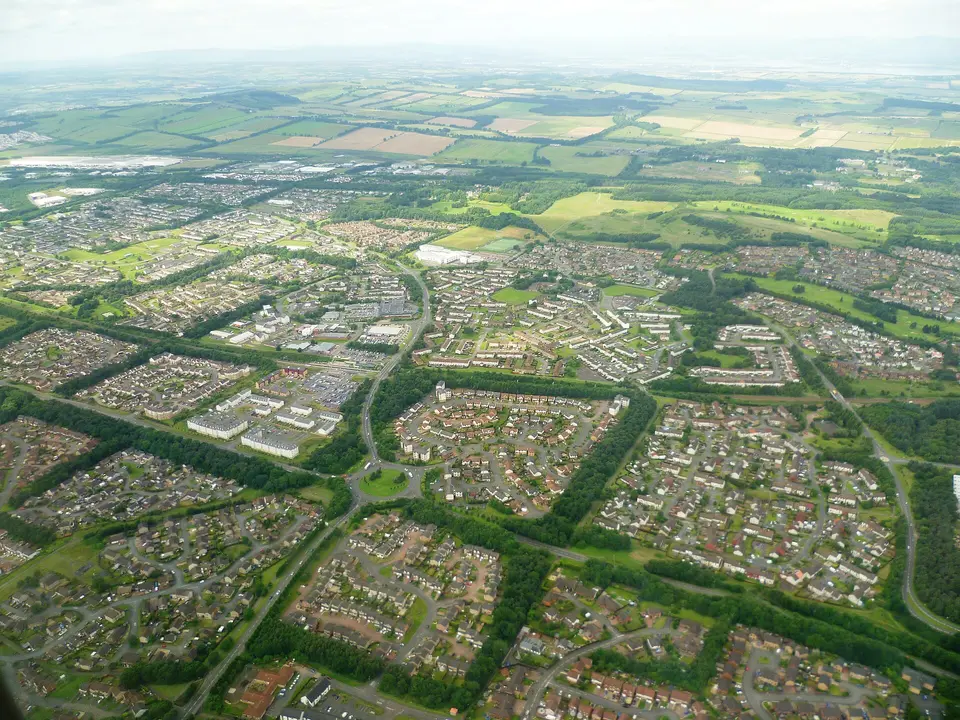
The original plan of 1962 allowed for up to 100,000 people, and the 1966 version imagined a regional population of 250,000. Neither number was reached, which is one reason Livingston still has so much open space between its districts.
The districts
Livingston is a collection of residential districts around a planned centre. Craigshill lies to the east, Deans and Knightsridge to the north, Ladywell and Eliburn to the west, Dedridge, Murieston and Bellsquarry to the south, with Howden and Livingston Village closer to the middle. Kirkton, Adambrae, Carmondean and Almondvale fill in between. Each district has its own guide on this site, starting from the district directory.
Most districts have a small cluster of shops, a primary school, a health centre and a pub, which was the planners’ idea of a neighbourhood. The big shopping, the council offices and the bus terminal are in the centre at Almondvale, described in the town centre guide.
Where people work
The new town was sold to industry from the start. Light manufacturing, electronics and pharmaceuticals moved in during the 1960s and 1970s, and Livingston became one of the hubs of Silicon Glen. Kirkton Campus, on the western edge, was Scotland’s first technology science park. Some of the biggest names left from the late 1990s, among them Burroughs, Motorola and NEC, and that was a hard time for the town.
The economy that replaced them is more mixed. Sky has a large customer contact centre at Kirkton Campus, though it cut jobs there in 2025. Tesco runs its distribution centre for Scotland and Northern Ireland on the northern edge of town. Schuh has its head office on the Deans Industrial Estate. Mitsubishi Electric makes air conditioning units and heat pumps on the Houston Industrial Estate, Glenmorangie has offices and a bottling plant at Alba Business Park, and Valneva makes vaccines in the town. Retail is a large employer too, given the size of the shopping centres, and so is the NHS through St John’s Hospital.
Health and education
St John’s Hospital in Howden opened in 1990. It has an accident and emergency department and around 550 beds, and it is a teaching hospital for the University of Edinburgh’s medical school. Before it opened, the area’s hospital was at Bangour, west of Dechmont.
Livingston has four secondary schools: Inveralmond Community High School, The James Young High School, St Margaret’s RC Academy and Deans Community High School. West Lothian College has its main campus in the town. There are three public libraries, at Almondbank in Craigshill, the Lanthorn in Dedridge and Carmondean in Deans.
Getting around
The town sits in a frame of three main roads: the M8 along the north, the A71 along the south and the A899 dual carriageway down the east side linking the two. Edinburgh is about 15 miles east, Glasgow about 30 miles west and Edinburgh Airport 7 miles away.
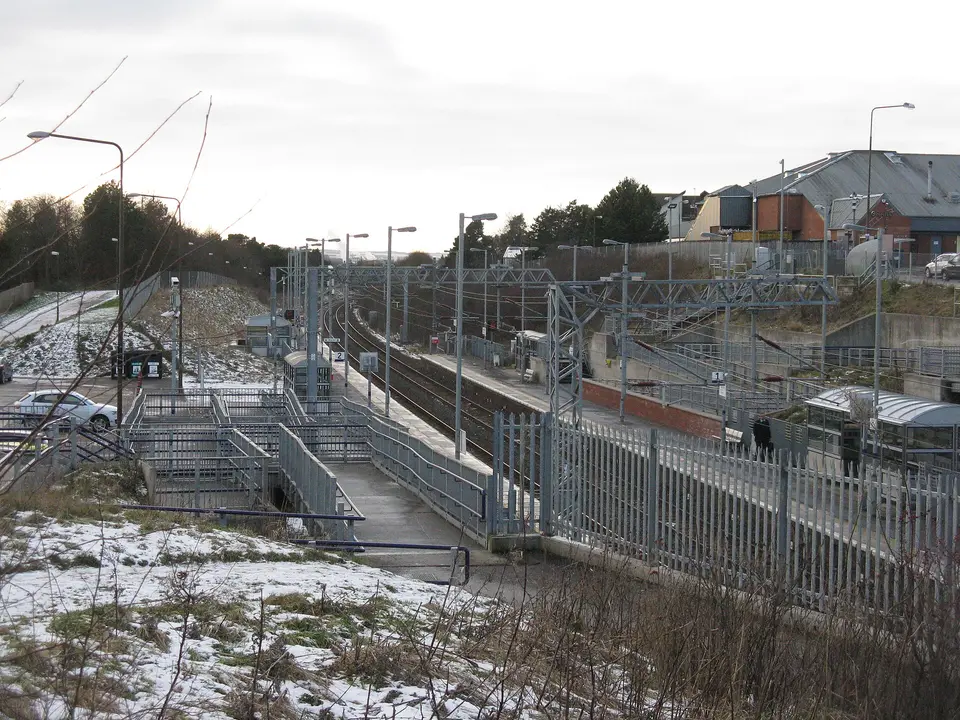
Three stations serve it. Livingston North, beside the Carmondean Centre, has trains to Edinburgh and to Glasgow Queen Street via Bathgate and Airdrie. Livingston South at Murieston is on the Shotts line between Edinburgh Waverley and Glasgow Central. Uphall station is on the eastern edge. Buses run from the terminal on Almondvale Avenue to Edinburgh, Glasgow, the airport and most of West Lothian, with Lothian Country the main operator.
The core path network deserves a special mention. Walkers and cyclists can cross most of the town on shared paths that pass under or over the roads, a legacy of the 1960s plan. It is one of the better things about living here, and visitors rarely discover it. The travel guide has more detail.
Shopping, leisure and faith
The town centre holds one of the largest shopping areas in Scotland. The Centre and the Livingston Designer Outlet face each other across Almondvale Avenue, and together they make up the largest indoor shopping location in the country. The Asda at the far end is the biggest of that chain in Scotland. The shopping guide covers it all.
For leisure, Howden Park Centre has a theatre of about 300 seats, the Almond Valley Heritage Centre at Millfield combines a farm, a narrow-gauge railway and the Museum of the Scottish Shale Oil Industry, and parks such as Eliburn, Almondvale, Howden and Peel give the town far more open ground than its size suggests. Deer Park Golf and Country Club is on the northern edge.
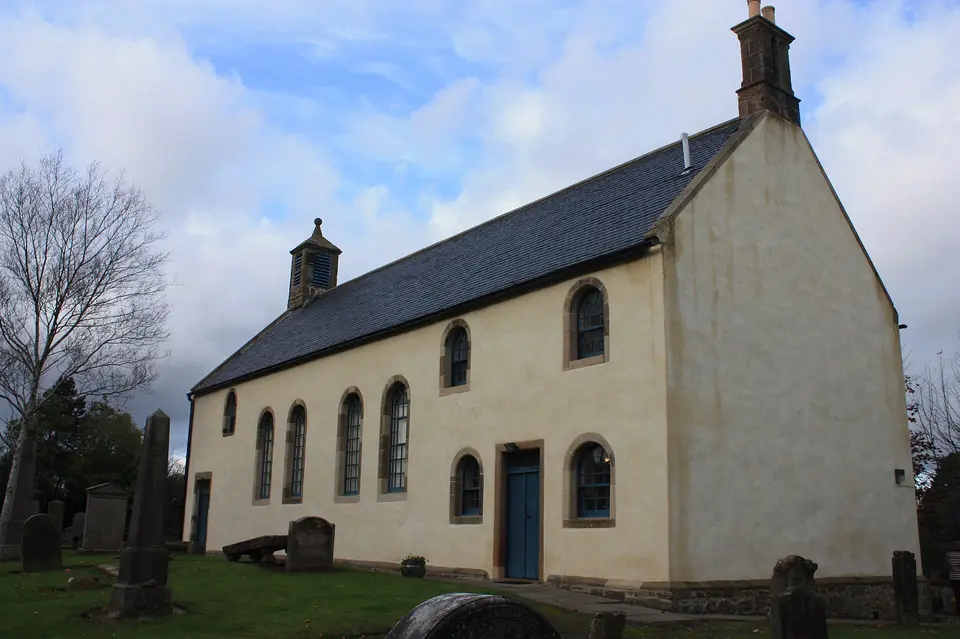
Religious life has its own new-town story. Uniquely in Scotland, Livingston was set up as a single ecumenical parish shared by the Church of Scotland, the Scottish Episcopal Church, the Methodists and the Congregationalists, based at the Lanthorn in Dedridge. There are Catholic churches in Carmondean, Craigshill and Dedridge, and Craigshill was home to West Lothian’s first mosque.
The local paper is the West Lothian Courier. For a few years the town even had its own radio station, River FM, broadcasting from Almondvale Stadium between 2003 and 2007, and the hospital radio at St John’s, Radio Grapevine, still runs.
How Livingston is governed
The Livingston Development Corporation planned and ran the town until 22 March 1997. Since then West Lothian Council has been responsible, and its headquarters are in the Civic Centre beside the River Almond, opened in November 2009. The town is covered by four council wards.
At Westminster, Livingston has had its own constituency since 1983. Its first MP was Robin Cook, who held the seat until his death in 2005 and served as Foreign Secretary from 1997 to 2001. At Holyrood the town is in the Almond Valley constituency.
The towns around it
Livingston is surrounded by older places, most of them with mining or shale oil histories of their own. Broxburn and Uphall lie to the north-east, Bathgate to the north-west, Mid Calder and East Calder to the south-east, and West Calder and Polbeth to the south-west, with the Pentland Hills beyond. Linlithgow, with its palace and loch, is a short drive north, and Edinburgh is close enough for a day out or a daily commute.
For trips beyond the town, see visiting West Lothian and the attractions guide. One last detail for anyone who likes odd connections: Livingston is twinned with Grapevine, Texas, a town on the edge of Dallas/Fort Worth International Airport, which suits a place that sits seven miles from Edinburgh’s.