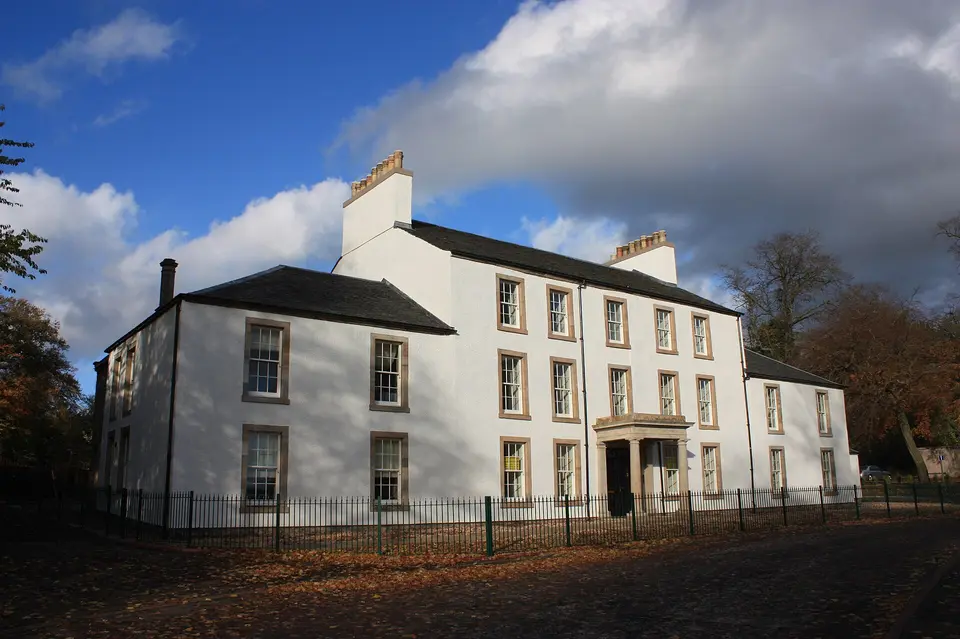
The house is the first thing you notice in Howden Park: three storeys of white harl and tall windows, standing at the top of a slope of grass with the town centre just beyond the trees. It looks older than everything around it because it is. Howden House was finished in 1795, nearly two centuries before most of Howden was built.
An estate older than the house
The land belonged to the Douglas family of Pumpherston and appears in records as far back as the 16th century, when it was called Over Howden. The present house was probably built for Thomas Farquharson of Howden and completed in 1795, a plain and well-proportioned country house of the kind the Lothian gentry put up in the late 18th century.
Its later owners read like a short tour of Scottish history. In 1834 the house passed to Henry Raeburn, the son of the portrait painter Sir Henry Raeburn, whose portraits of Edinburgh society now hang in the National Galleries of Scotland. Later the daughter of James Young, the chemist whose paraffin works made West Lothian the centre of the world’s first oil industry, lived at Howden until her death in 1931. The estate was then sold to Sir Adrian Baillie of Polkemmet, who bought it for his mother, Lady Baillie.
The bomb of June 1940
Just after midnight on Tuesday 25 June 1940, a single bomb fell on the coach house and stables. Mrs Maria Fleming and her granddaughter Margaret, aged ten, were killed. They were the first civilians to die in an air raid on the Scottish mainland, and the only people killed by bombing in West Lothian during the Second World War.
It is a strange fact to set beside the building that now stands on the same ground. The stable block that was hit is the one that later became the town’s arts centre.
After the war
Lady Baillie lived at Howden until she died in 1946. The Ministry of Agriculture then bought the estate and used the land to test agricultural machinery.
The new town arrived in the 1960s. Rather than build over the estate, the planners kept the grounds south of the house as open parkland, and Livingston grew up around it. The Livingston Development Corporation bought the house itself for use as a community centre, with support from the Carnegie United Kingdom Trust.
That use did not last. The house went through some two decades of neglect before West Lothian Council sold it to a private developer, who converted it in 2012 and 2013 into one large townhouse and four smaller flats. From the outside it looks much as it always did, and it is a Category B listed building.
Howden Park Centre
The arts centre is the reason most people come. The former stable block was converted into a venue and opened as Howden Park Centre in 1972, with the actor Andrew Cruickshank doing the honours. The architects Nicoll Russell Studios carried out a major refurbishment in 2009.
The centre has a theatre with around 300 seats and hosts plays, concerts, recitals and community performances. Firefly Youth Theatre, formerly West Lothian Youth Theatre, is based here too. If you want to know what is on, the centre’s own listings are the place to look, because programmes change every season.
Neighbours in Howden
The house is not the only large building in the district. St John’s Hospital, which opened in Howden in 1990 with an accident and emergency department and around 550 beds, took over from the old hospitals at Bangour. The contrast is striking: a Georgian laird’s house at one end of the park, a modern teaching hospital not far away, and the 1960s and 1970s housing of Howden in between.
Howden Park
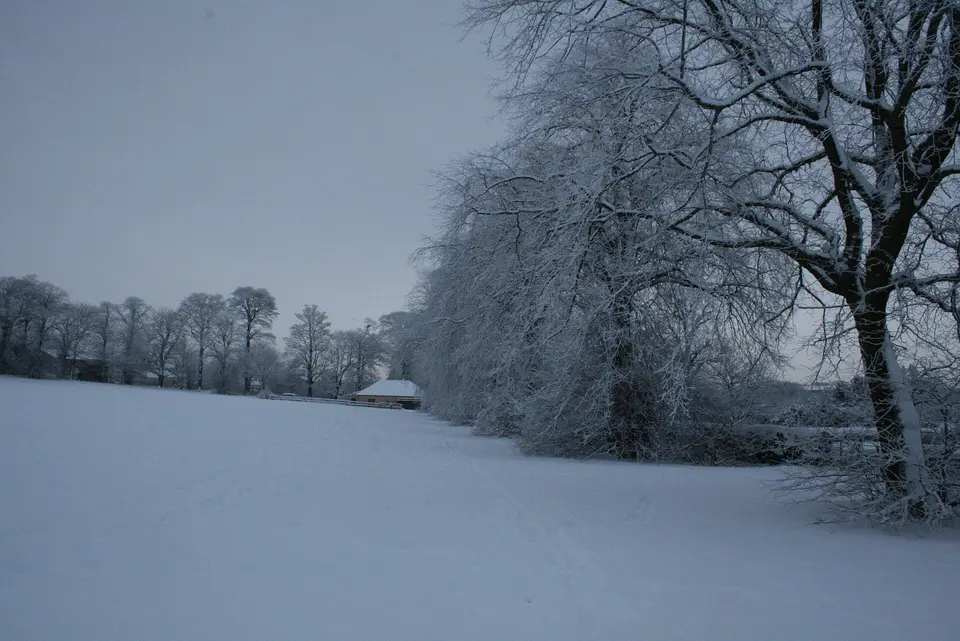
The park in front of the house is the other half of the story. It stretches south and east towards the town centre and the River Almond, and it is one of the most used open spaces in Livingston: dog walkers in the morning, school groups at lunchtime, people cutting through to the shops all day. The Howden district guide covers the streets and paths around it, and the architecture guide explains how the new town planners worked around older buildings like this one.
A footbridge across the Almond links the park side to the Civic Centre and the town centre car parks, so the house is easy to combine with a visit to the shops. In spring the slope below the house is one of the better places in town to sit for ten minutes.
Finding it
Howden House stands just north of the town centre, between Howden and the Almond. From the bus terminal on Almondvale Avenue it is a short walk across the river and up through the park.
A good loop on foot takes you from the house down through Howden Park, along the river past the Civic Centre and back through the shopping centre. Look back at the house from the bottom of the slope: it is the one view in central Livingston where you can still see what this ground looked like before 1962.